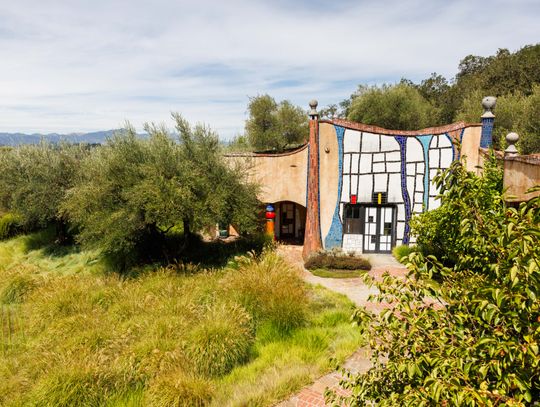
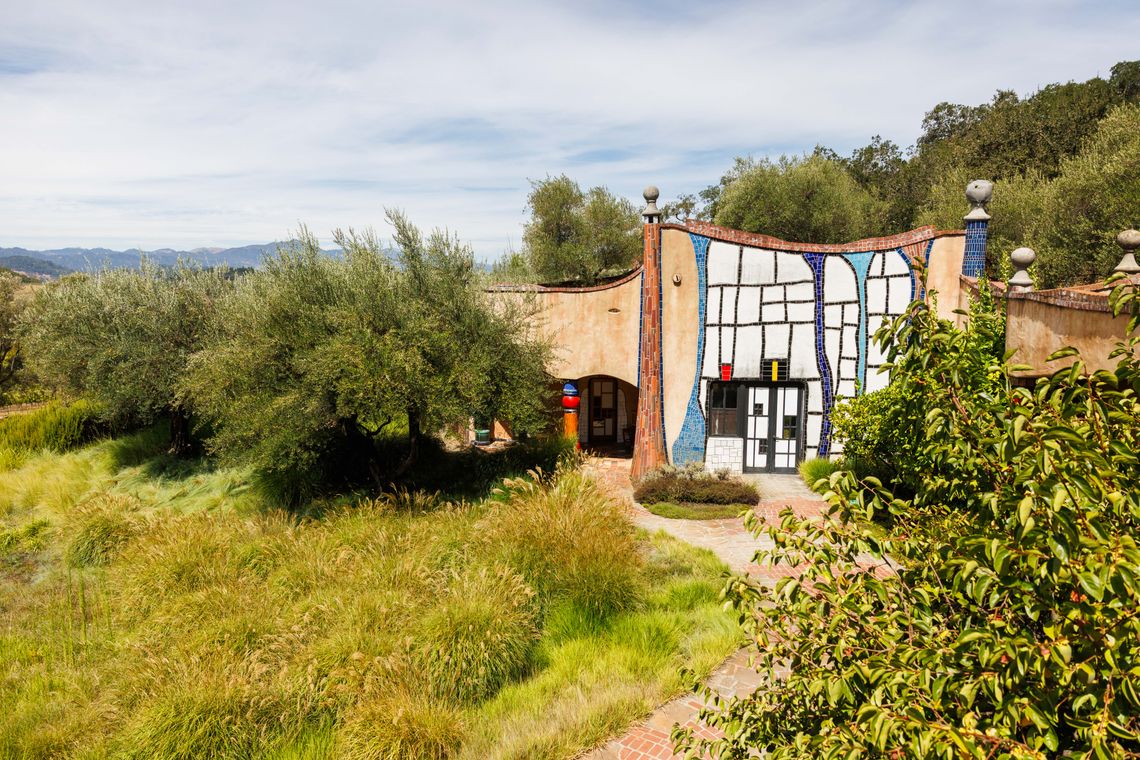
There’s no large sign announcing Quixote Winery from the Silverado Trail, just a small marker in the middle of others that’s easy to drive past if you’re not looking for it. Those who do make the turn climb back into the hills of the Stags Leap District on roads often divided in two to make two-way travel possible.
Eventually, the Napa Valley disappears behind you as you follow one or two more small signs to a nondescript parking lot beside a creek. On a sunny day, you might see the winery’s gold onion dome catch the light and guide you the rest of the way.
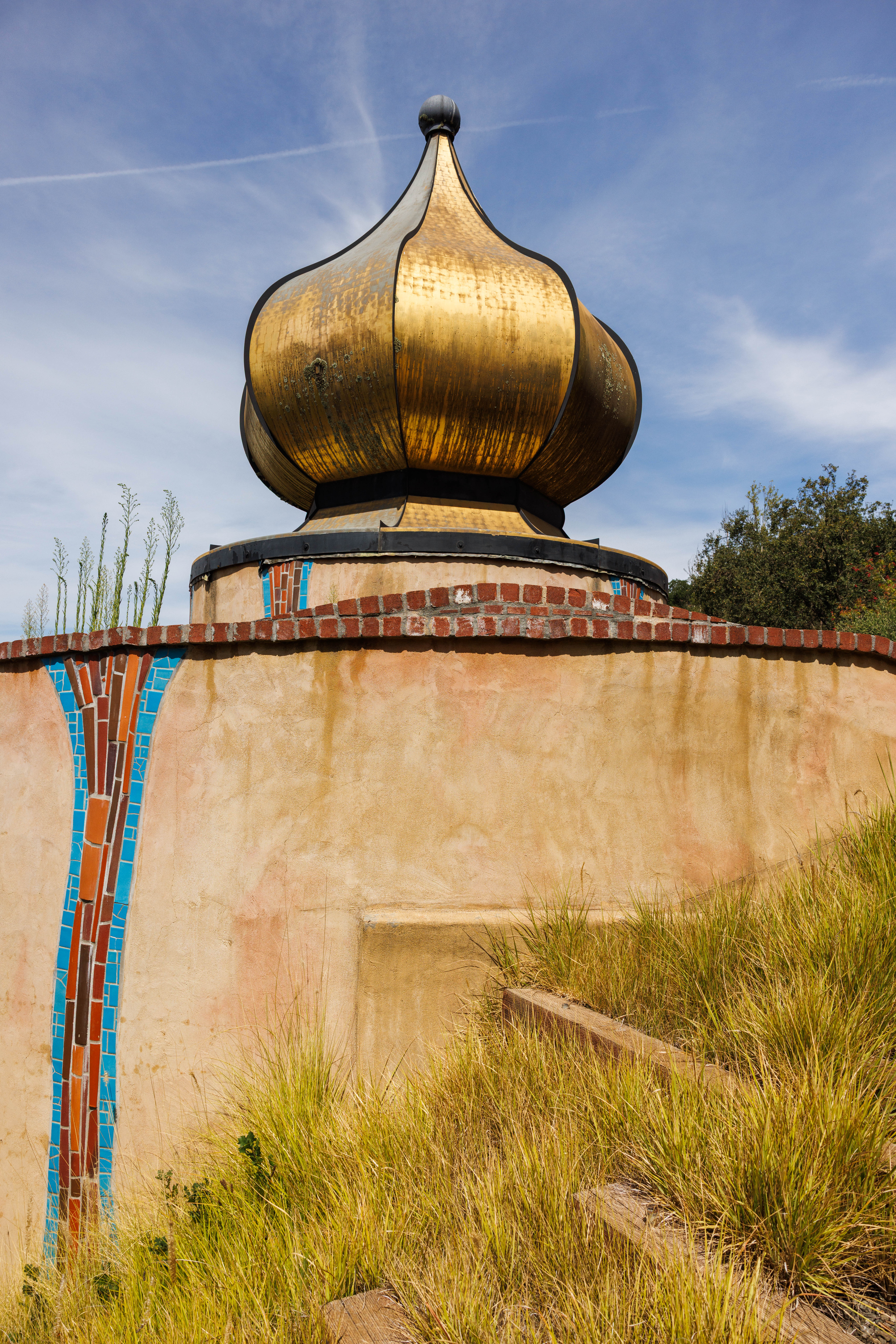
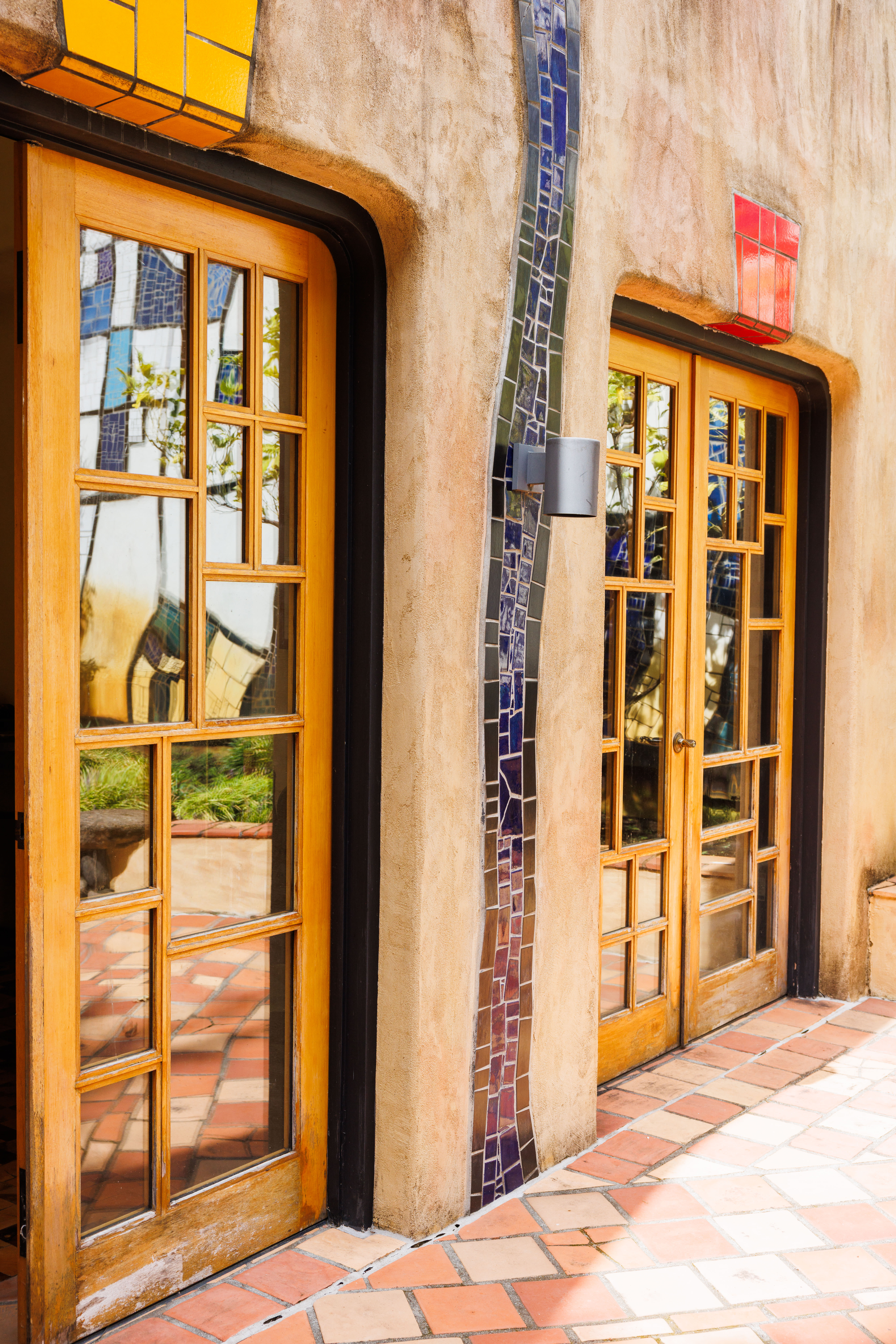
The building underneath it doesn’t have a straight wall. Windows arrive in whatever shape and size the room seemed to want. Columns rise in stacked, mismatched ceramic beads, no two alike. The floor tilts and dips underfoot, tile giving way to uneven stone and back again, by design rather than neglect. Visitors are gently, almost affectionately, warned about it by staff who’ve had years to get used to it themselves.
It looks, depending on who you ask, like a dream, a fever, or a mistake that got finished anyway.
It is, in fact, the only building in the Western Hemisphere designed by the Austrian painter, architect and provocateur Friedensreich Hundertwasser.
Hundertwasser is the last person on earth one would expect to build a winery in Napa Valley. That he did is thanks to Carl Doumani, a UCLA dropout turned restaurateur turned reluctant vintner, who spent his whole life proving he didn’t much care for straight lines either.
Doumani found Hundertwasser almost by accident. By the late 1980s, he’d already built and sold Stags’ Leap Winery and was looking to start something smaller and stranger next door. Sitting in the office of a San Francisco architect one afternoon, weighing designs that weren’t landing right, he noticed a calendar on the wall — prints of an artist he didn’t recognize, all curved lines and impossible color.
“This is more what I’m looking for,” he reportedly told the architect.
He tracked the artist down that summer — Friedrich Stowasser, who by then went almost exclusively by the name he’d given himself, Hundertwasser. Doumani flew to Vienna in 1989 to meet him in person, carrying, by one account, little more than a bottle of wine and a conviction that this was the right person for the job.
What he found waiting for him was not exactly an architect — Hundertwasser had never trained as one. He’d started as a painter, drifted into activism — public toilets, license plates, transportation policy — and had, by his own manager’s description, become “a completely free person.”
Over the better part of a decade that followed, letters and design revisions crossed the Atlantic between them, along with Hundertwasser himself, flying in a handful of times from Vienna or New Zealand to check on progress.
What eventually rose out of the hillside was neither man’s alone — not quite Doumani’s winery, not quite Hundertwasser’s manifesto, but something that needed both of them to exist at all.
Friedrich Stowasser was born in Vienna in 1928 to a Jewish mother and a father who died just a few months after his birth. When Nazi Germany annexed Austria in 1938, Stowasser and his mother survived by passing as Catholic, with a young Friedrich even being enrolled in the Hitler Youth.
While Allied bombs fell and the persecution of Jews tightened around them, mother and son spent the final years of the war hiding in the basement of a Jewish ghetto apartment. By the end of World War II, an estimated 69 of Stowasser’s relatives had been rounded up and killed in concentration camps.
Even while in school, he displayed an almost strange fluency with color. A surviving report card from the Montessori school he attended when he was five notes an “exceptional understanding and affinity” for it.
As a young man, he saw the design movements around him, such as brutalism, prize conformity and repetition. Stowasser actively rebelled against those traditions, with everything in his later work insisting on the opposite — nothing flawless, nothing repeated, nothing in a line.
By his 20s, he’d begun giving himself new names, one for each chapter of his life.
He translated Stowasser, which he mistakenly believed derived from a Slavic word for “hundred,” into Hundertwasser — hundred waters. At 33, married to a Japanese artist and living in Japan for a time, he rendered his first name in kanji and expanded it to Friedensreich — “peaceful realm.”
At 40, he bought an old wooden freighter in Sicily and sailed it to Venice, where he lived aboard a boat he’d named Regentag, “Rainy Day,” for good measure. Late in life, having settled part time in New Zealand, he took one final name, Dunkelbunt, for vibrant, radiantly deep color.
Put together, his full adopted name ran nine syllables long: Friedensreich Regentag Dunkelbunt Hundertwasser. Friends and colleagues just called him Hundertwasser.
He gave lectures in the nude. He sewed his own clothes. He was, by his own manager’s description, “a completely free person.” By the time Carl Doumani found him, in the late 1980s, that freedom had never once resolved itself into a straight line.
The design principles Hundertwasser built read less like an architect’s brief than a manifesto. Trees, he believed, were tenants entitled to grow out of their own windows if that’s what they wanted, since they had the same rights as any resident to decorate. Every horizontal surface open to the sky, he argued, should be a green space, which is how a winery ended up with a living roof and about a dozen full-grown olive trees rooted in 30 inches of soil. Floors, in his buildings, were never flat because an uneven walking surface, he liked to say, was “a melody for the feet.”
Columns received their own philosophy.
“Next to a column, one feels as under a tree,” he wrote. “A column must be beautiful and colorful and shine in the rain and in the moonlight of its own accord.”
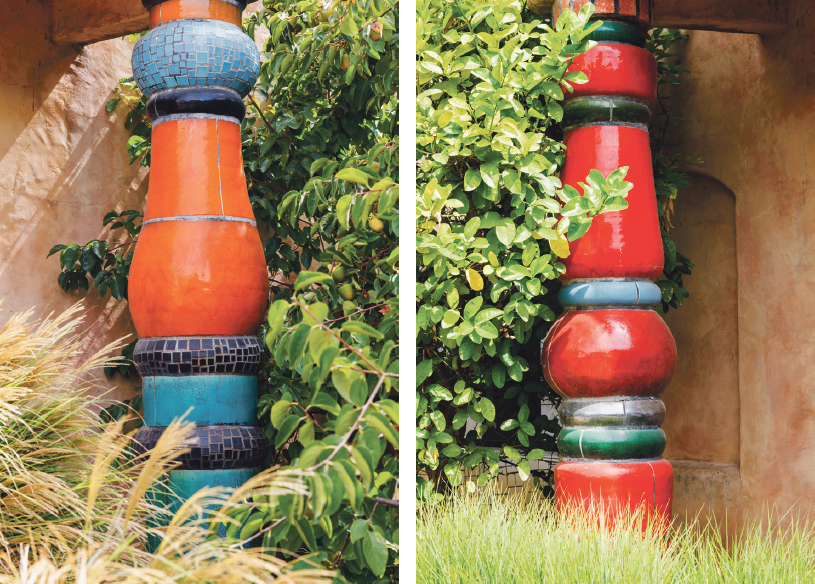
At Quixote, his trademark columns took the form of oversized ceramic beads, stacked and mismatched, no two alike. Even the keystones over the doorways carried meaning. Although structurally unnecessary, he insisted on them anyway, comparing a doorway without one to “a man with no necktie” — technically complete, but missing the thing that finishes the picture.
Underneath all of those philosophies rested one foundational line, blunter than the rest, that Hundertwasser had been repeating since his earliest days as a painter and would go on to tell The New York Times decades later — “The straight line is godless.”
To a man who’d watched conformity curdle into something far darker in his own childhood, grids, right angles and repeated forms were not neutral choices. A building, like a life, could refuse to fall in line.
It would take Carl Doumani 10 years to see those philosophies come to life.
When he first came to see the land for himself, Hundertwasser’s first instinct was to bury the whole winery. The landscape was too beautiful to interrupt, he reportedly told Doumani, so it was better to dig it underground and leave the hillside untouched.
Doumani, a Californian to his core, talked him out of it. This was sunshine country. People wanted to be outside.
The building was, instead, split into two wings around a central lobby, meant to evoke a man with his arms spread — one arm for the tasting room, the other for wine production. Designing the winery took about three years, and the construction took seven more.
Hundertwasser was rarely on-site for any of it, splitting his time between Vienna, where he was finishing an apartment complex, and New Zealand. He flew in for occasional site visits and leaned heavily on the tradesmen doing the work.
By most accounts, he was unusually generous about the arrangement. He’d ask the carpenters and tile-setters what they’d do with a given wall or column, and craftsmen would show up on weekends with their families just to see what they’d built.
The columns represented the biggest challenge. Hundertwasser’s trademark design — oversized, mismatched ceramic beads — required a lead-based glaze that no American producer was permitted to use. Doumani’s search eventually led him to Germany, where a craftsman could match the specifications. The columns were built, shipped across the Atlantic, and reassembled on-site without incident.
Hundertwasser’s reaction on seeing them finished was to pick up a hammer.
He walked up to the nearest column and shattered it.
“If they don’t see we use broken materials, they’ll never know,” he reportedly said at the time.
He moved on to some of the floor tiles next, for good measure. One column still standing in the lobby today carries the marks of that same afternoon.
Nobody, including the winery’s current staff, is entirely sure what the whole project ended up costing. Doumani stopped trying to track it.
“If we kept track of what we spent, we wouldn’t have done it,” Doumani said.
Carl Doumani never cared much for straight lines either.
He dropped out of UCLA at 20 to buy into a Westwood barbecue spot, putting up $200 he didn’t entirely have. He was too young, at the time, to legally buy or sell a drink in the restaurant he now partly owned. More restaurants followed, then a career in property development, then Napa.
In 1969, Doumani and his wife went looking for a small weekend property, five or 10 acres, no hills.
“I wasn’t paying for up and down,” he liked to say.
His broker showed him 400 sloped acres, anchored by a Victorian manor that had sat abandoned for 17 years.
“You son of a bitch, you hooked me,” Doumani told him, and bought it anyway.
The initial plan was to open a country inn, but zoning laws killed that idea. Within a year, Doumani moved his family into the property full time instead.
Vineyards came with the land, planted decades earlier and mostly ignored. In 1971, a stranger knocked on his door asking to buy the fruit.
It was Robert Mondavi. His interest, along with some advice on fixing up the derelict winery buildings, was enough to push Doumani into wine himself. Stags’ Leap Winery followed within the year.
Doumani ran Stags’ Leap for two and a half decades, feuding publicly with his neighbor Warren Winiarski over whose winery got to use the name “Stags Leap.”
The fight dragged through the courts until 1986 and became known, with the apostrophe as its battlefield, as the “War of the Apostrophes.”
He quit the Napa Valley Vintners Association in 1985 over what he considered excessive politicking, becoming a founding member of a rival lunch club with the deliberately ridiculous name GONADS — an acronym for the Gastronomical Order of Nonsensical and Dissipatory Society. He bottled his wine under screw caps years before it was fashionable, over the objections of Portuguese cork producers who flew in to plead their case in person.
He sold Stags’ Leap to Beringer in 1997 for a reported $17 million and kept the acreage next door for himself. As his 2025 obituary would later put it, he was “about to make his biggest play yet in the world of art and architecture.”
Quixote runs today with only a handful of employees who know the place well enough to love it. The wildlife, which Estate Host Ashleen Blaettler calls the “second shift,” doesn’t wait for the tasting room to close.
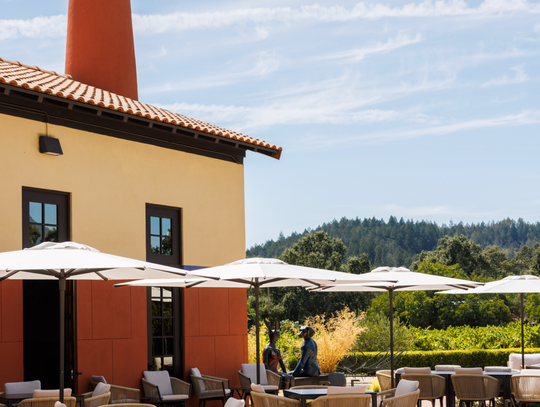
Deer have wandered past guests mid-pour. Egrets work the pond by the old private residence. Bats occasionally take up residence in the rolled umbrellas on the patio, only to be discovered when someone goes to open one.
Once the last car pulls out and the property empties for the night, the coyotes and deer take it back over, and with almost no light pollution for miles, the stars do the rest.
Through all of it, the winery has stayed committed to something that makes very little commercial sense — Petite Sirah, a grape most of the valley abandoned decades ago in favor of Cabernet Sauvignon. The tasting room pours two vintages side by side, same winemaker, same vineyard, different growing seasons — inky, tannic, an acquired appreciation that the estate has never tried to dilute into something easier to sell.
It is less a job than a kind of stewardship — a small group of people trying to look after something strange and singular long enough that other people learn to love it too.
Hundertwasser died in February 2000, at 71, having spent his final years splitting time between Vienna and a stretch of New Zealand coastline he’d come to love as much as anything he ever built.
By his own arrangement, he was buried without a coffin, directly in the earth of his island property, under a tulip tree. New Zealand doesn’t ordinarily allow that kind of burial, but he got special dispensation anyway.
Quixote — located at 6126 Silverado Trail in Napa —remains the only Hundertwasser building anywhere in the Americas.
Doumani outlived him by a quarter century, selling Quixote in 2014 and spending his final years on a two-acre passion project of a different kind, a private label made from what was left of the estate’s hillside fruit. He died at home on April 22, 2025, at 92, reportedly while taking a nap.
Neither man, in the end, ever got around to building, or living, in a straight line. What they left behind still sits up above the Silverado Trail, past a sign easy enough to miss if you’re not looking for it, floors uneven underfoot, waiting on whoever finds it next.